
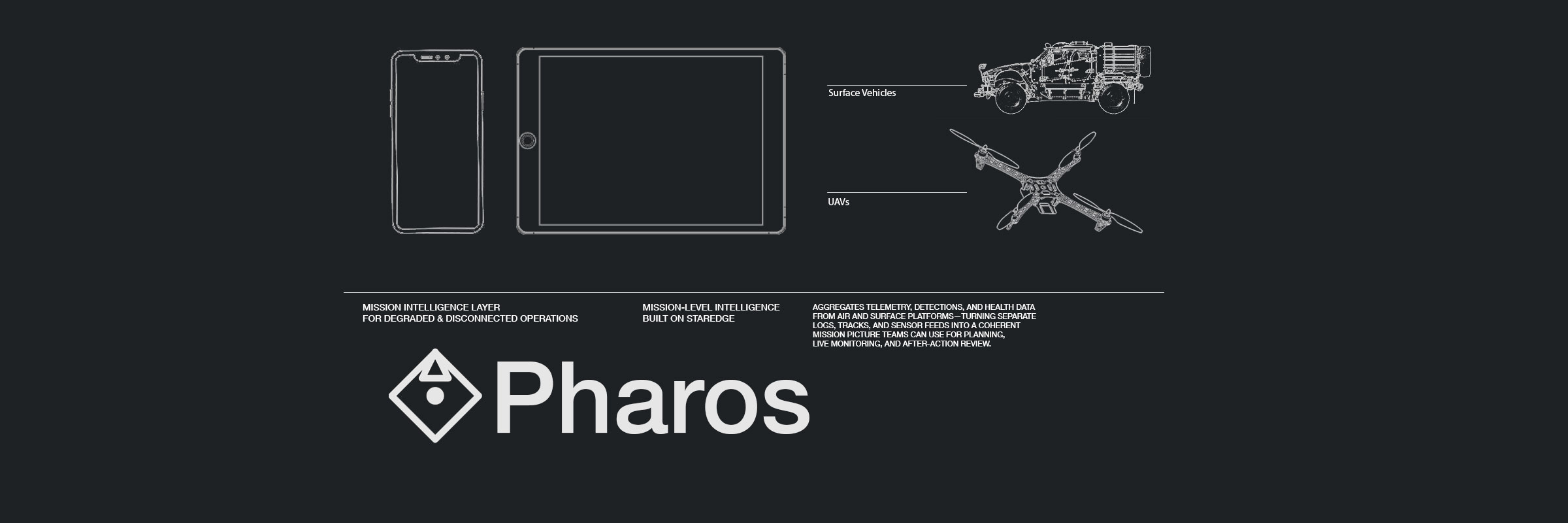
Pharos autonomy & mission intelligence research
Pharos is Rendeer Systems' autonomy and mission intelligence research stack for small unmanned and edge systems. It spans experiments in guidance and flight control behaviors, sensor fusion for navigation, and mission-level telemetry and timelines that turn raw data into a coherent mission picture for planning, live monitoring, and after-action review.
Inputs
Telemetry streams, detections, health and status updates, and mission timelines from air, ground, maritime platforms, fixed sensors, and edge compute nodes.
Outputs
Unified tracks, mission timelines, alerts, and summaries for operators, command systems, and downstream analytics tools.
Targets
Small unmanned systems, fixed and mobile sensors, and StarEdge or other edge compute nodes across air and surface domains.
Under the Pharos umbrella, we also run experiments with onboard guidance and flight control behaviors for small multirotor and ground platforms. These flight-control prototypes are internal R&D tools used in simulation and controlled field tests and are not offered as commercial flight controller products.
Capabilities
Built for real-world operations.
Unified mission picture
Combines telemetry, detections, video metadata, and operator events from multiple platforms into a single mission view with shared timelines and maps.
Cross-domain fusion
Correlates air, ground, maritime, and fixed sensors so teams can understand what is happening across assets and domains, even when individual feeds are intermittent or degraded.
Disconnected-friendly design
Designed to work with logs and streams from disconnected and degraded environments, and to synchronize mission history when connectivity allows, without requiring constant backhaul.
Interfaces
Connects to the systems you already use.
Pharos is designed to sit alongside existing control stacks, sensors, and edge compute. It ingests telemetry and state over standard protocols, turning separate feeds into a normalized mission view without replacing flight controllers or radios.
MavLink and similar telemetry
Consumes navigation, attitude, and mission messages from Ardupilot, PX4, and other compatible stacks for display, fusion, and alerting, without taking over low-level control.
NMEA and GNSS-style feeds
Ingests position and timing data expressed as NMEA sentences or equivalent from systems that may be operating in degraded or contested environments.
Custom and vendor APIs
Adapter layer for proprietary or vendor-specific telemetry and event APIs, enabling Pharos to pull data from consumer and commercial systems without exposing low-level internals.
Example ingestion mapping
# Telemetry ingestion
MAVLINK_MSG_GLOBAL_POSITION_INT -> PHAROS_TRACK
MAVLINK_MSG_ATTITUDE            -> PHAROS_STATE

# NMEA ingestion
NMEA_GGA, NMEA_RMC              -> PHAROS_TRACK

# Normalized mission view
PHAROS_MISSION_VIEW {
  tracks:   fused_tracks[]
  events:   mission_events[]
  health:   platform_health[]
}
Integration
Bring existing platforms into a single mission view.
01 · Connect feeds
Expose telemetry, detections, and health streams from drones, surface vehicles, sensors, and edge nodes using existing protocols.
02 · Normalize and tag
Map raw messages into Pharos' common schema, tag assets and missions, and align events on unified timelines.
03 · Review and act
Use the Pharos mission view for planning, live oversight, and after-action review, or export data into other analysis tools.